Tuesday, 30 September 2014

Monday, 29 September 2014
Photoshop Trial
 |
This is a front cover I made when practicing Photoshop. To get the background black and white I used the lasso tool on the image in the centre and then put it onto a new layer. This meant I could change the colour of the background yet keep the image in the centre the same. The masthead wasn't very eye-catching before, so I added used the drop shadow effect, the gradient overlap effect, the bevel & emboss effect and the stroke effect. I did the same on the strap line as well.

Continuing with my Photoshop practice, I made a poster advertising the 'magazine'. I used the same font and effects so they match the magazine's masthead and to catch the reader's attention. The original background was white, which I felt was too plain and not eye-catching enough. I replaced the background with the image that is on the magazine (only in black and white) so it matches and to make the poster less plain.
Feedback:
This is the feedback from my lecturer and my peers.


Thursday, 25 September 2014
Article Attempt 1
This was my first attempt at writing an article, with my lecturer's feedback on it.


When I write an article for my own magazine I will use images, pull quotes, captions and other conventions which I have learned about.


When I write an article for my own magazine I will use images, pull quotes, captions and other conventions which I have learned about.
Wednesday, 24 September 2014
Reader Profile
On surveymonkey I have uploaded another survey about what the target audience likes and habits, which will help me with my reader profile.
Reader profile survey
These are the results so far:
NME's reader profile:
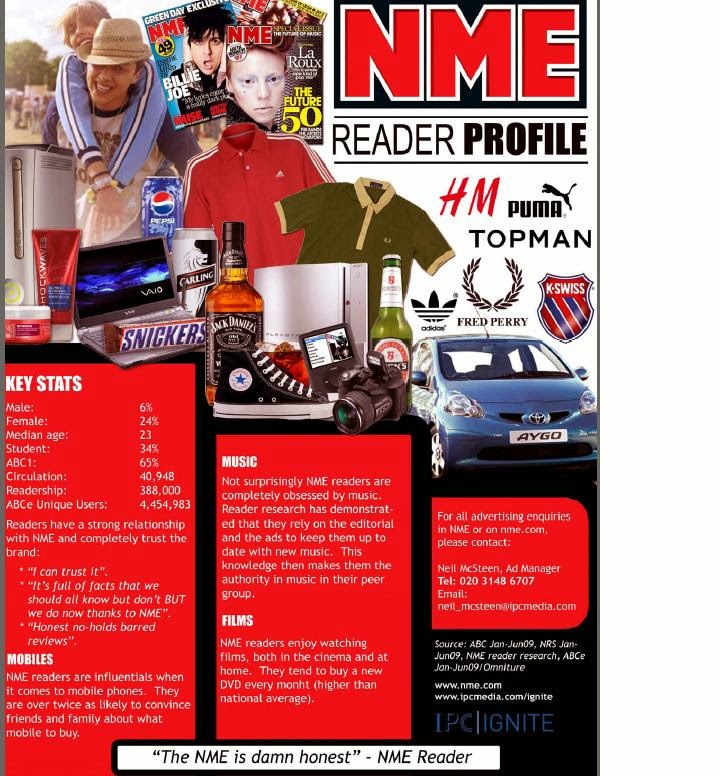
NME's reader profile helped me as it showed me what kind of information to put on, how to layout my reader profile and what questions to ask my target audience on my survey.
This is my own reader profile:

Reader profile survey
These are the results so far:
NME's reader profile:
NME's reader profile helped me as it showed me what kind of information to put on, how to layout my reader profile and what questions to ask my target audience on my survey.
This is my own reader profile:

These findings justify my initial ideas that my readers are unemployed students in their teens with little disposable income and who have an interest in TV shows, shopping and social media. Since my readers prefer home-cooked food I may reference that in my article.
Monday, 22 September 2014


Saturday, 20 September 2014
Genres of music
My magazine will cover the genres rock and metal. There are different sub-genres of rock and metal.
Pop Punk
Pop punk (also known as pop-punk or punk-pop) is a fusion music genre that combines elements of punk rock with pop music to varying degrees. The music typically combines fast punk tempos, chord changes and loud guitars with pop-influenced melodies and lyrical themes.
Grunge
Grunge (sometimes referred to as the Seattle sound) is a sub-genre of alternative rock that emerged during the mid-1980s in the American state of Washington, particularly in Seattle. The early grunge movement revolved around Seattle's independent record label Sub Pop, but by the early 1990s its popularity had spread, with grunge acts in California and other parts of the US building strong followings and signing major record deals.
Thrash Metal
Thrash metal is a sub-genre of heavy metal music that is characterised by its fast-tempo and overall aggression. The songs usually use fast percussive beats and low-register guitar riffs, overlaid with shredding-style lead work. The lyrics often deal with social issues and reproach for the establishment, often using direct and denunciatory language, an approach which partially overlaps with the hardcore genre.
Hard Rock
Hard rock (or heavy rock) is a loosely defined sub-genre of rock music which had its earliest roots in mid-1960s garage rock, blues rock and psychedelic rock. It is typified by a heavy use of aggressive vocals, distorted electric guitars, bass guitar, drums, and often accompanied with pianos and keyboards.
Metalcore
Metalcore is a broad fusion genre of melodic death metal and hardcore punk. The name is an amalgam of the names of the two genres, distinguished by its emphasis on breakdowns, which are slow, intense passages that are conducive to moshing.
Blues Rock
Blues rock is a musical genre combining bluesy improvisation over the twelve-bar blues and extended boogie jams with rock and roll styles. The core of the blues rock sound is created by the electric guitar, piano, bass guitar and drums, with the electric guitar usually amplified through a tube guitar amplifier, giving it an overdriven character.
Heavy Metal
Heavy metal (or simply metal) is a genre of rock music that developed in the 1960s and early 1970s, largely in the United Kingdom and the United States. With roots in blues rock and psychedelic rock, the bands that created heavy metal developed a thick, massive sound, characterised by highly amplified distortion, extended guitar solos, emphatic beats, and overall loudness. Heavy metal lyrics and performance styles are often associated with masculinity, aggression and machismo.
Nu Metal
Nu metal is a fusion genre of heavy metal that combines elements of metal music with elements of multiple genres, most notably genres like hip hop, funk and grunge. It is part of the alternative metal genre.
Pop Punk
Pop punk (also known as pop-punk or punk-pop) is a fusion music genre that combines elements of punk rock with pop music to varying degrees. The music typically combines fast punk tempos, chord changes and loud guitars with pop-influenced melodies and lyrical themes.
Grunge
Grunge (sometimes referred to as the Seattle sound) is a sub-genre of alternative rock that emerged during the mid-1980s in the American state of Washington, particularly in Seattle. The early grunge movement revolved around Seattle's independent record label Sub Pop, but by the early 1990s its popularity had spread, with grunge acts in California and other parts of the US building strong followings and signing major record deals.
Thrash Metal
Thrash metal is a sub-genre of heavy metal music that is characterised by its fast-tempo and overall aggression. The songs usually use fast percussive beats and low-register guitar riffs, overlaid with shredding-style lead work. The lyrics often deal with social issues and reproach for the establishment, often using direct and denunciatory language, an approach which partially overlaps with the hardcore genre.
Hard Rock
Hard rock (or heavy rock) is a loosely defined sub-genre of rock music which had its earliest roots in mid-1960s garage rock, blues rock and psychedelic rock. It is typified by a heavy use of aggressive vocals, distorted electric guitars, bass guitar, drums, and often accompanied with pianos and keyboards.
Metalcore
Metalcore is a broad fusion genre of melodic death metal and hardcore punk. The name is an amalgam of the names of the two genres, distinguished by its emphasis on breakdowns, which are slow, intense passages that are conducive to moshing.
Blues Rock
Blues rock is a musical genre combining bluesy improvisation over the twelve-bar blues and extended boogie jams with rock and roll styles. The core of the blues rock sound is created by the electric guitar, piano, bass guitar and drums, with the electric guitar usually amplified through a tube guitar amplifier, giving it an overdriven character.
Heavy Metal
Heavy metal (or simply metal) is a genre of rock music that developed in the 1960s and early 1970s, largely in the United Kingdom and the United States. With roots in blues rock and psychedelic rock, the bands that created heavy metal developed a thick, massive sound, characterised by highly amplified distortion, extended guitar solos, emphatic beats, and overall loudness. Heavy metal lyrics and performance styles are often associated with masculinity, aggression and machismo.
Nu Metal
Nu metal is a fusion genre of heavy metal that combines elements of metal music with elements of multiple genres, most notably genres like hip hop, funk and grunge. It is part of the alternative metal genre.
Friday, 19 September 2014
Monday, 15 September 2014
Target Audience
To do my research I conducted a survey on surveymonkey.
Music magazines survey
These are the results I collected:
I asked these questions because they would give me an idea of what the target audience looks for in a magazine and what their hobbies and interests are. This way I can tailor my magazine to include conventions, references and advertisemnets that would interest and please my readers.
My target audience would be mainly young people of both genders in their teens or twenties. They would be a student who does not have a lot of money, but still saves up for things they like, such as comic books, video games and CDs. Their favourite genres of music would be rock and metal and they would enjoy going to gigs. They may also play an instrument, like guitar or drums
This is a quick sketch of what my target audience's interests and personality.

Music magazines survey
These are the results I collected:
I asked these questions because they would give me an idea of what the target audience looks for in a magazine and what their hobbies and interests are. This way I can tailor my magazine to include conventions, references and advertisemnets that would interest and please my readers.
My target audience would be mainly young people of both genders in their teens or twenties. They would be a student who does not have a lot of money, but still saves up for things they like, such as comic books, video games and CDs. Their favourite genres of music would be rock and metal and they would enjoy going to gigs. They may also play an instrument, like guitar or drums
This is a quick sketch of what my target audience's interests and personality.

Monday, 1 September 2014
Welcome
Welcome
Hi there
and welcome to my blog. This is where I will be posting my research for my A
Level Media Studies projects and updates on their progress.
Aims Of The Course
The aims of these specifications are to:
• enhance
candidates enjoyment and appreciation of the media and its role in their daily
lives;
• develop
critical understanding of the media through engagement with media products and
concepts and through the creative application of practical skills;
• explore
production processes, technologies and contexts;
become independent in research skills and their application.
Briefs
When centres choose briefs to offer to candidates,
they should be guided by their strengths in terms of resources and expertise.
Centres should also bear in mind the key areas: forms and conventions,
production contexts, the role of technologies, audiences/users and
representations.
The set briefs are as follows:
Preliminary exercise: using DTP and an image
manipulation program, produce the front page of a new school/college magazine,
featuring a photograph of a student in medium close-up plus some appropriately
laid-out text and a masthead. Additionally candidates must produce a DTP
mock-up of the layout of the contents page to demonstrate their grasp of the
program.
Main task: the front
page, contents and double page spread of a new music magazine (if done as a
group task, each member of the group to produce an individual edition of the
magazine, following the same house style). Maximum four members to a group.
Subscribe to:
Posts (Atom)